What happens to peace when difference is treated as danger rather than strength?
History offers sobering reminders of the consequences. One of the most devastating examples is the Holocaust, when Nazi ideology built on racial superiority and extreme intolerance led to the systematic persecution and murder of millions of people, primarily Jews, but also Roma communities, people with disabilities, and others labeled as “unworthy.” Peace was destroyed when entire groups were stripped of dignity, belonging, and the right to exist. Remembering moments like these invites us to reflect on how deeply respect for diversity is tied to the preservation of peace.
Respecting the many ways people differ from one another is essential to fostering peace. Diversity refers to the identities, experiences, and perspectives that make each person and community unique. It includes race, ethnicity, culture, language, religion, gender, ability, age, nationality, and lived experience, but it also encompasses the histories, values, and ways of knowing that shape how people move through the world. At its core, respect for diversity rests on a shared truth recognized globally: all human beings are born free and equal in dignity and rights. This principle, affirmed in the Universal Declaration of Human Rights, reminds us that every community carries inherent worth and richness, whether it is acknowledged or not.
Having identified how diversity shapes our communities and why it matters, we turn to inclusion, the active practice of creating spaces where all people feel valued, seen, and able to participate fully. Inclusion goes beyond simply acknowledging differences; it requires intentionally removing barriers, amplifying marginalized voices, and ensuring that everyone has the opportunity to contribute and thrive.
One way to understand inclusion is to see it as a continuum, a process that unfolds over time rather than a single action. At one end, there is exclusion, where certain people are ignored or left out entirely, often because of who they are or where they come from. Next comes tolerance, a stage in which differences are acknowledged but not fully valued; people may be allowed to participate, yet their perspectives have little influence. Moving further along, we reach acceptance, where diversity is recognized and respected, and people feel seen for who they are. The highest level is inclusion, where every voice is actively welcomed, systems are intentionally designed to support participation, and diverse perspectives genuinely shape decisions.
For example, imagine a local community meeting. At the exclusion stage, only a few familiar members are invited, leaving others unheard. At tolerance, newcomers might attend, but are mostly observers. Acceptance would mean everyone’s opinions are listened to and respected. True inclusion, however, ensures that the meeting’s agenda, decision-making, and follow-up actively incorporate contributions from people of all backgrounds, making each participant feel valued and empowered to shape the outcomes.
Below is an image illustrating this continuum, adapted from Jennifer Brown’s model (Unaware → Aware → Active → Advocate) to show how inclusion develops over time.
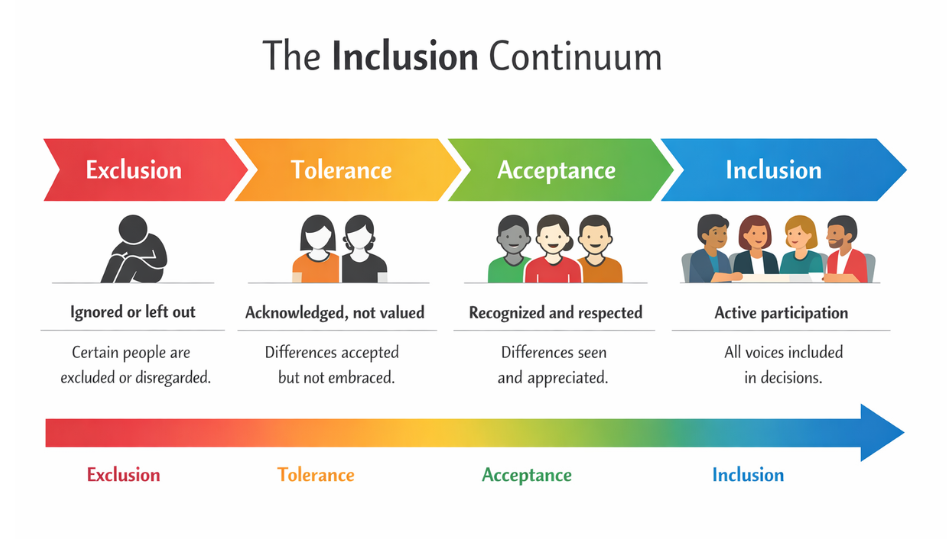
The Inclusion Continuum: from exclusion to full participation. Adapted from Jennifer Brown’s 4-Stage Model.
Equity goes hand in hand with inclusion, ensuring that respect for diversity is not just symbolic, but actively supported through fair treatment, access, and opportunity. While inclusion focuses on participation and voice, equity addresses the structural and systemic barriers that prevent certain groups from thriving. Promoting equity means recognizing that people start from different places and may need different resources, support, or accommodations to fully contribute and belong. When equity is embraced, communities can bridge gaps caused by historical, social, or economic disparities, creating environments where all individuals are empowered to participate. In this way, equity strengthens the foundation for lasting peace, because it nurtures fairness, reduces resentment, and fosters mutual understanding across differences.
Together, diversity, equity, and inclusion form the foundation of a peaceful and just society. Respecting differences, creating spaces where all voices are valued, and ensuring fair access and opportunities allow communities to thrive while reducing conflict and fostering understanding. Respecting diversity through equity and inclusion is not a one-time effort, but an ongoing commitment to recognize the inherent worth of every person and to build systems, relationships, and cultures that reflect that recognition.
Commit today to respecting diversity in your own life. Seek out different perspectives, include those whose voices are often unheard, and advocate for fairness and equity wherever you can. Every action toward respecting diversity strengthens peace, trust, and belonging in the world we share.

Brenda Awuor is a Kenyan-based environmental writer, researcher, environmental journalist, and sustainability marketer. Her work spans the full spectrum of environmental issues, including sustainability, pollution, biodiversity, and climate change. She is the founder of EcoVoicing, a sustainability communications and green marketing platform that helps amplify environmental brands and supports their marketing efforts through clear, credible, and impact-driven storytelling. Trained in environmental journalism and grounded in a solutions journalism approach, Brenda is deeply committed to storytelling as a tool for understanding and finding solutions to environmental challenges, advancing equity, and fostering peace by highlighting pathways toward collective and lasting change. She believes that environmental stewardship and peace-building are inseparable, rooted in respect for people, land, and future generations.